"Patent Pending" Provisional Rights

Recently a client asked me to sue a competitor for infringement on her patent application. I told her that even though you can mark articles with the terms "Patent Applied For" or "Patent Pending" these phrases have no legal effect, but only give information that an application for patent has been filed in the United States Patent and Trademark Office. The protection afforded by a patent does not start until the actual grant of the patent.

However, damages for pre-patent grant infringement by another are now available. The American Inventors Protection Act, 35 U.S.C. § 154(d) gives the inventor provisional rights:

“patents issuing on published applications will include the right to obtain reasonable royalties from others who, with actual notice of the published application, made used, sold, offered to sell, or imported the invention as claimed in the published application before the patent was granted.”

Once a patent application is published, an applicant may assert provisional rights. Publication occurs 18-months following the filing date or priority date claimed by an application. These § 154(d) provisional rights provide a patentee with the opportunity to obtain a reasonable royalty from a third party that infringes a published application claim provided:

  • actual notice is given to the third party by applicant (the inventor probably needs to send a cease-and-desist letter), and
  • a patent issues from the application with a substantially identical claim.

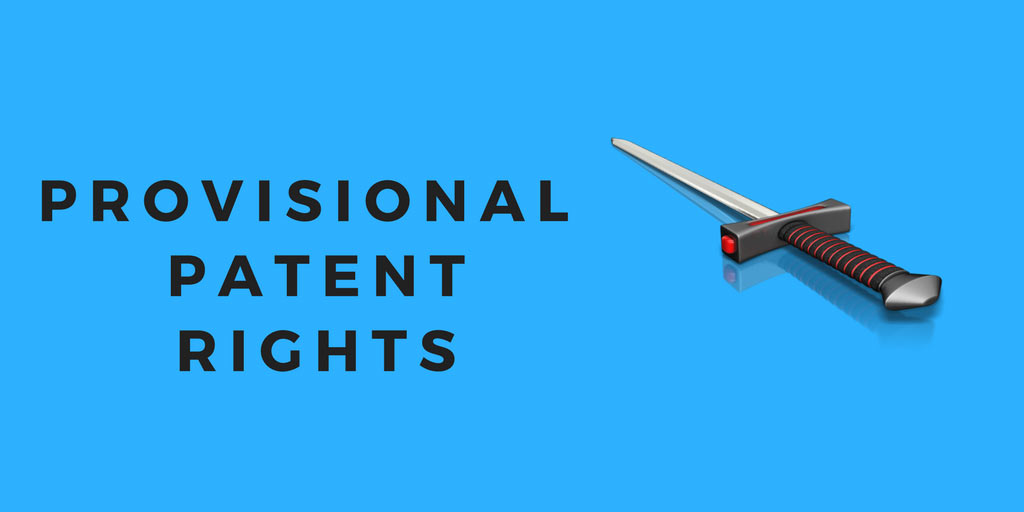
Having this ability to protect an invention is a powerful sword in the inventor’s bag of weapons. swordIt is risky business for your competition to take the chance and sell a patent pending product because they can be sued at a later date and possibly be forced to take all their products "off the shelf."

But what about the shield? How does the inventor protect an invention? If you give your competition notice of your published application is it possible they will submit documents to shoot down your patent? And what can you do to shoot down somebody else's patent or patent application?

Following publication, the application for patent is no longer held in confidence by the Patent Office and any member of the public may request access to the entire file history of the application in Patent Application Information Retrieval (PAIR). What are the available ways a competitor can submit prior art against an issued patent or pending patent application to the United States Patent and Trademark Office?

  1. Third-Party Submissions in Patent Applications (37 C.F.R. 1.99)
  2. Protests Against Published Applications (37 C.F.R. 1.291)
  3. Citation of Prior Art in Issued Patents (37 C.F.R. 1.501)

1. Third Party Submissions pursuant to 37 C.F.R. 1.99 are:

  • Submissions by the public of patents or publications only
  • During the pendency of a published application

Third Party Submissions must be filed within two months from the date of publication of the application (§ 1.215(a)) or prior to the mailing of a notice of allowance (§ 1.311), whichever is earlier. This really isn't a big window of time. How would anyone even know it was published unless they were constantly searching the United States Patent and Trademark website? Based on this law, I would suggest not giving anyone notice of your pending patent application until at least two months after publication.

2. A protest, pursuant to 37 C.F.R. 1.291, may be filed by:

  • Any member of the public, including private persons, corporate entities, and government agencies
  • In a pending patent application
  • Will be matched with application file if adequately identifies the patent application.

A protest has to be filed before publication or before a notice of allowance. This rule has always bothered me. I think this time constraint should be addressed through patent reform because there aren't many ways to find out whether an application is pending unless it's published. I would guess you would need some sort of inside information. Or based upon the marking of patent pending on an object you might guess there is an application,but then you'd have to act as a Detective and find out the application number because it isn't published.

3. Citation of Prior Art in Issued Patents (37 C.F.R. 1.501) may be filed by:

  • Any person, individual, corporate or government entity, real parties in interest, persons without a real interest
  • May submit patents or publications along with an explanation
  • Having a bearing on the patentability of any claim in a particular patent

I'd like to throw this out for discussion, why does the patent office make it so difficult to either submit third-party submissions or protests by limiting the time in which you can file these types of submissions? How could you protest and identify a patent application if it's not even published? And isn't two months from publication such a narrow time period that makes it very difficult for anyone to even find out that there is a pending published application for a Third Party Submission?

"Clipart courtesy FCIT"

Nike "Back to the Future" Patent Application

Recently I authored a blog post regarding whether or not you can patent an idea? Remember you can get a patent for the" thing" you make not the idea.

nike patent

In order for an idea to become a patented invention, the inventor must be able to teach someone of ordinary skill in the art how to make and use the invention.

I used the example of the “idea” for the transporter in the Star Trek television series as an idea that can only be patented if someone could make it.

What about the "Back to the Future" movie where Michael J. Fox has automatic clothes and automatic sneaker laces.

Well, I found this cool video on YouTube and the actual patent application (.PDF) by Nike. Take a look. What do you think?

Post-Bilski Guidelines for USPTO Patent Examiners

The United States Patent and Trademark Office (USPTO) has prepared further interim guidance for the patent examining corps to use when determining subject matter eligibility of a  business method patent application under 35 U.S.C. § 101 in view of the recent decision by the United States Supreme Court in Bilski v. Kappos (.PDF).

uspto

This interim guidance, which was published in the Federal Register July 27, 2010, is a supplement to previously issued interim instructions dated August 24, 2009, and it supersedes the interim guidance memo to the examining corps dated June 28, 2010.

The USPTO is seeking public comment on this interim guidance and intends to issue final guidance after evaluating the public comments. Any member of the public may submit written comments on the Interim Bilski Guidance.

Comments concerning this Interim Bilski Guidance should be sent on or before September 27, 2010 by e-mail to Bilski_Guidance@uspto.gov or facsimile transmitted to (571) 273–0125.

Other related posts:

Senator Leahy Uses Bilski to Push Patent Reform

USPTO Sends Bilski Memo to Patent Examiners

Bilski vs. Kappos Decision

Bilski vs Kappos

Legal community weighs in on Bilski v. Kappos

Business method patents...what will the Supreme Court Do?

New Apple Patent Application: Generating a Book

Tweet of the week

Thanks to @ifones for tweeting this week about how Apple may take on a new role in video gaming if its latest patent application, published by the U.S. Patent and Trademark Office last week, ever makes it into a product.

Take a look how Patently Apple breaks down the Apple patent application that teaches new methods to convert a computer user's video game play into a "book, e-book, or comic book."

Apple Apps

Patent Search Add-on for Firefox: Aspator

The United States Patent and Trademark Office (USPTO) web page is not very user friendly when searching for prior art patents. But I found an add-on for Firefox called Aspator that makes it much friendlier.

The Aspator add-on works with search pages for patents and patentadd-on for Firefox applications on the USPTO and the European Patent Office (esp@cenet) websites.

Aspator is designed for inventors, engineers, scientists, patent agents, patent attorneys, and patent executives who search patents regularly.

I’ve used it for a few patent searches now and I like how everything is built right into the USPTO website. No having to go to multiple pages for different features, especially for downloading a .PDF copy, everything comes up right on the USPTO search page.

Another great feature is that searches can be manipulated and saved, and your own personal comments added. The comments are conveniently located and will come in handy when writing a patent opinion. It simply brings all patent information to one page. This feature will save so much time looking for patents that I just looked at because you do not have to hit the “back” button 20 times to return to previously viewed patents.

I will definitely keep this Ad-on on all my computers.

Features of Aspator:

  1. Read searched patent abstracts, claims, drawings and bibliographies from USPTO and esp@cenet on a single page.
  2. View USPTO patent drawings directly. No need to install TIFF viewer.
  3. Instant translation of patent abstract.
  4. Patent classification analyzer.
  5. Direct access to esp@cenet and Google Patent Search.
  6. Download PDF of an entire patent with  one click.
  7. Download multiple patents in one single PDF file or in separate PDF files.
  8. Store your search records with your comments.

I liked the Aspator add-on so much I decided to interview the Developer Kenneth Yip and learn why Aspator was created and find out what's next for this add-on. Here is the interview:

Q: Can you give us a little background about yourself?

A: I was born and raised in Hong Kong. My family immigrated to Toronto when I was in high school. I earned a bachelor degree in electrical engineering from the University of Waterloo, and a master’s degree in electrical engineering from Stanford University.

After worked for a telecom research company in New Jersey and two startups in New York City, I moved back to Hong Kong to work for a research institution. In the research institution, I was responsible for all IP maters and spent most of my effort in patent searches, reviewing patent applications, and IP licensing. I then earned a LLB from University of London external program. Now, if everything goes smoothly, will become a lawyer in Hong Kong later this year specializing in tech and IP.

Q: Do you have any experience searching patents and what got you into creating add-ons for patent searches?

A: As I needed to search patents regularly and found Delphion a bit overpriced (or too powerful for my need) and slow, I began thinking of different ways to improve patent search efficiency. Also, at about the same time, Firefox became popular. Because of these two factors, I decided to create Aspator.

Q: One problem many users have with the USPTO website involves viewing images of patents and drawings, which are in TIFF format. Even if a user has a TIFF viewer, such as Alternatiff, conflicts with programs such as Apple’s Quicktime can make TIFF files difficult to display properly. Does Aspator help with this issue?

A: Yes, as there is also a big issue with printing TIFF files embedded in a web page. In the newest version of Aspator, 1.0252, Aspator will allow a preview of pages 2-4 of a patent/patent application without a TIFF viewer by converting TIFF images to PNG images, a much more common and easily-viewed image format. Pages 2-4 are usually the first 3 diagrams of a patent/patent applications. If there is a demand, future versions of Aspator will turn all images from TIFFs to PNGs.

Q: When testing out the Aspator add-on for Firefox I was impressed with the ability to save search results for later use, when you created this feature how did you envision it to help a searcher?

A: Haha, I love this feature. I believe this feature will distinguish a casual patent searcher from a professional patent searcher. A casual patent searcher will only search patent once in a few months and may not need this feature. On the other hand, a professional patent searcher needs to deal with many patent search requests a day and may find this feature useful.

Q: What do you think the most important features are for the Aspator add-on for Firefox?

A: I would say it is the ability to show the patent contents along the search result.

Q: Did you apply for any patents regarding this add-on?

A: No. As most features of Aspator are about information display and simple HTML parsing, there is not much need for patent application. However, I have at least 15-20 features in my to-do-list. Two or three of them I believe are quite "revolutionary" and worth for patent protection. Hopefully, these features would be able to leave Delphion in the dust:)

Q: Why did you pick the name Aspator?

A: A person (or) who is an ace (as) in patent (pat).

Q: What what can tell me abut the lifespan of Aspator?

A: One happy thing that Aspator users need to know about is the life span of Aspator. The value of Aspator is inversely proportional to the value and features provided by USPTO, esp@cenet or Delphion.

It is my sincere hope that one day I can stop thinking about Aspator because a patent search in USPTO, esp@cenet or Delphion becomes very powerful and user-friendly.

Continue Reading...

How Do Inventions Come About?

Whoever invents or discovers any new and useful process, machine, manufacture, or composition of matter, or any new and useful improvement thereof, may obtain a patent therefor..."  35 U.S.C. 101

A patent on an invention may not be obtained if the differences between the invention sought to be patented and the prior art are such that the invention would have been obvious at the time it was made to a person having ordinary skill in the art to which the invention pertains. Patentability shall not be negatived by the manner in which the invention was made. 35 USC 103

That last sentence basically means that if an invention came about because of many hours of diligent work and effort or in a flash with no effort at all it doesn’t affect whether it is patentable... even if invented by accident.

How Do Inventions Come About?

  • Identification of a problem
  • Finding a new way to solve the problem
  • Scientific method
  • Trial and error
  • Hypothesis
  • Accident

There are many products that were invented by accident that changed the world but here are examples of a couple interesting inventions that came about accidentally:

Accidental Invention – Popsiclepopsicle patent®

In 1905 an 11 year old Frank Epperson mixed some soda water powder and water, which at the time was a popular drink. He left the mixture outside overnight with the stirring stick in it. The temperature dropped to a record low that night and the next day Frank had a stick of frozen soda water. In 1923 Frank Epperson began a business producing Epsicles in seven fruit flavors. The name was later changed to the Popsicle®.

Frank realized the commercial possibilities of his invention and was granted a patent in 1924. By 1928, Epperson had earned royalties on more than 60 million Popsicle® ice pops. In 1998 Popsicle® celebrated its 75th anniversary and continues to be one of the top frozen novelty brands in America. The trademark is registered to Unilever Supply Chain, Inc.

Accidental Invention – Post-it Notes®

Post-it® Notes was actually the product of an engineering mistake by 3M scientists who accidentally stumbled upon an adhesive that could stick and be repositioned on just about any surface. Spencer Silver was working in the 3M research laboratories in 1970 trying to find a strong adhesive. Silver developed a new adhesive, but it was even Post-it Notesweaker than what 3M already manufactured. It stuck to objects, but could easily be lifted off. It was super weak instead of super strong.

Another 3M scientist named Arthur Fry was singing in the church's choir and used Silver's adhesive to coat his markers. Success! With the weak adhesive, the markers stayed in place, yet lifted off without damaging the pages. 3M began distributing Post-it ® Notes nationwide in 1980 -- ten years after Silver developed the super weak adhesive. Today they are one of the most popular office products available. 


Accidental Invention – The Slinky®slinky

In 1943 during World War II, Richard James an engineer in the United States Navy saw a torsion spring fall to the floor and flip-flop as he watched. James and his wife Betty James perfected a long steel ribbon tightly coiled into a spiral. They began production of Slinkys® out of 80 ft of wire in 1945 under the company name James Spring & Wire Company. According to one estimate more than 300 million Slinkys have been sold. In 1998, Betty James sold the Slinky to Poof Products, Inc.