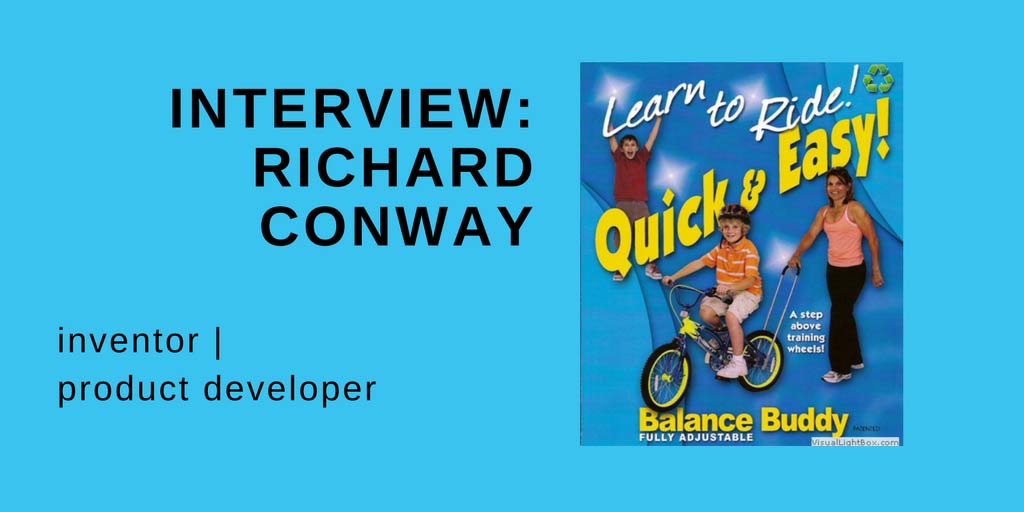
As a father of four, Richard P. Conway was helping one of his children learn how to ride a bike and while trying to hold on and run behind the bicycle, he thought, "there has to be a better way."
From there his journey as an Inve
ntor to new product developer began. He has since received a United States Patent, registered the trademark (pdf) and brought his first invention the "Balance Buddy" to almost every national retailer in the country. Now he is helping other inventors do the same thing. To share his success, Richard founded, Ingenious Products Inc. to help other inventors bring their ideas to market.
He agrees it wasn't an easy road and he learned a lot of lessons the hard way, that's why he hopes to help other inventors avoid some of the same pitfalls. He graciously agreed to answer a few questions about what inventors need to know...
Tell me a little about you and how did you get started as an inventor?
I got started solving common problems around the home. I was so excited and passionate about my inventions I immediately began presenting my inventions to companies that could sell my product. I quickly realized this was a huge error because I had not taken the necessary steps to properly protect my idea from being ripped off by others. That is exactly what happened. Because of those bad experiences.I now make sure each product has the necessary protection.
What is the first thing a new inventor should consider?
I encourage all inventors to first take a hard and detailed look at their invention. At the idea stage it is very critical to determine there is a large enough market/need to sell the product. Without demand there is no retail/license opportunity. Most inventors rush into this process because of their passion and enthusiasm and overlook the real importance of their target market. Remember it is all about selling your invention! Long-term financial success is market dependent.
What should a new inventor do after they have determined the target market?
Determine sale price. Before a product can be manufactured you must estimate early on whether your target market can afford to purchase the product.
Determine the cost to manufacture the product. The cost estimate needs to be as accurate as possible. Underestimating the cost will lead to financial ruin! Some factors that enter into the equation and are often over looked by inventors: manufacturing materials; assembly; customs charges; freight-case boxes; barcodes-graphics; work-packaging design, packaging costs; inventory; warehousing; processing orders; fulfillment; logistics and much more…..
What are things an inventor should avoid?
Most inventors rush into this process because of their excitement and passion. STOP everything and seek professional advice from a patent attorney first. This professional will be able to give you valuable insight and guidance early on whether your invention has initial merit. Then the inventor must answer some very critical questions: Who is going to manufacture their product? Can I afford to have the product made? How am I to sell the product? Is the target market big enough to make selling it worth while? What is the true cost of the invention? Will retailers be interested in the product? Can retailers make money selling the product? And much more….
How did you finance your business, and how have your finances changed as you've grown your business?
I was be able financed my business initially through my personal savings however it took much more than I had ever expected. Like most inventors capital is limited so deciding early on the direction you want to go is very critical to be successful in the whole process.
There are only 3 options to this step:
- You fund the process totally by yourself (including family and friends)
- You sell or license your invention to a company that specifically handles that type of product for a very modest or low royalty.
- You partner with a company that has a variety of products and is interested in adding your invention /product to the products it currently sells. This is basically a hybrid of option1 &2. Here you still get a royalty however it is typically significantly higher.
Why is it higher you should ask? It is really quite simple, the company is interested in expanding into a new product segment/market to increase their sales and take market share from current competitors. Make no mistake about it, these are the only 3 options available.
Are you selling your products, and what sorts of licensing deals do you have in place?
Yes, our company focuses on seeking out new innovative products that are potentially in demand in large markets. Product demand first and foremost. We nearly exclusively prefer to partner with inventors and their products where we provide the depth and resources needed to develop and sell a product in national and international markets. We have placed products with most of the major national retailers targeted to the mainstream consumer. We seldom target niche markets or the specialty retail segment.
For for the rest of the interview, see after the jump.
Continue Reading...